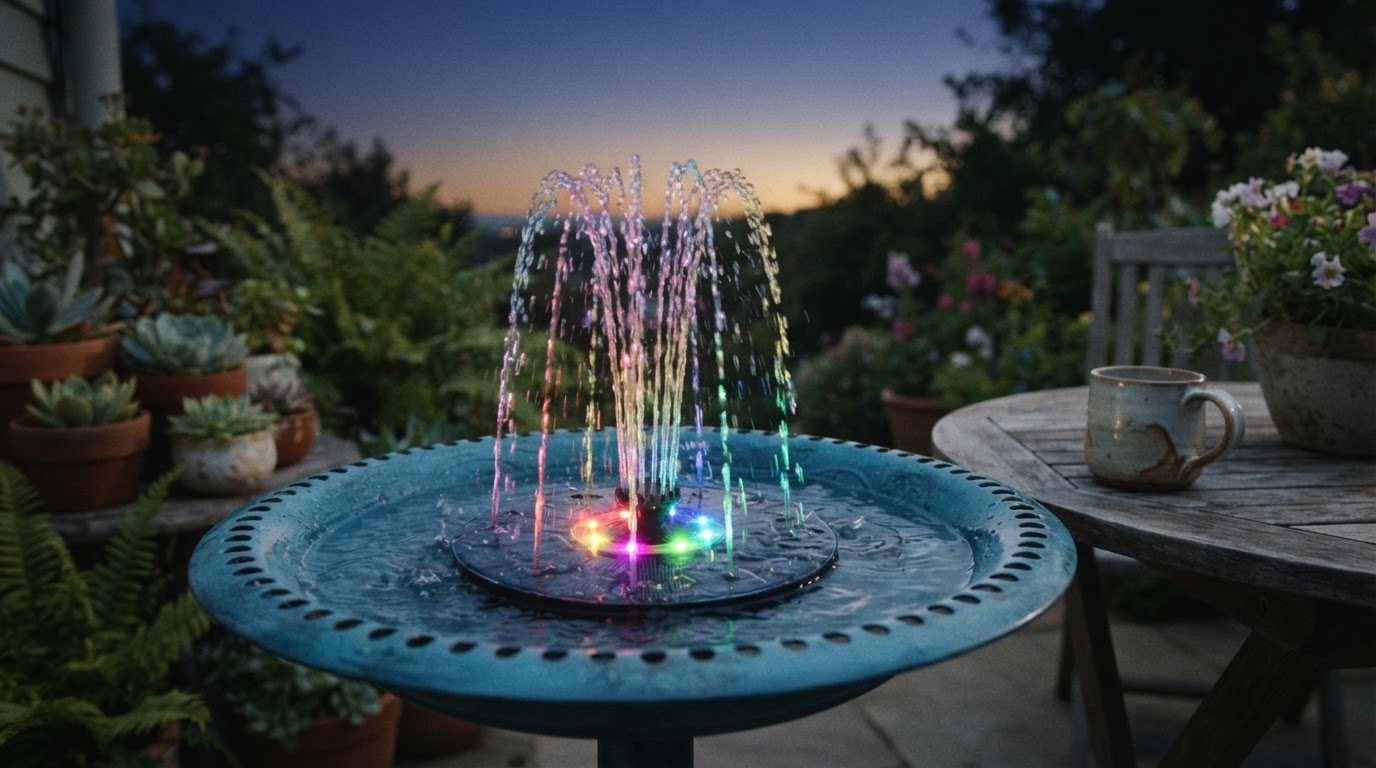
Colorful Solar Fountain Pump for Nighttime Bird Baths
 Daniel OkaforField Tester
August 10, 2026. This evaluation explores how integrating multi-color LED illumination into a solar-powered water feature transforms a standard garden pond after sunset. It is written for homeowners who want to maintain a wildlife-friendly habitat while adding a decorative light element to their landscape.
The Challenge of Stagnant Water and Nighttime Visibility
I tested this for two weeks in a shaded corner of my yard, and the first thing I realized is that a bird bath without movement is essentially a mosquito nursery. According to Duncraft, keeping water circulating is critical to attract more birds and discourage mosquitoes. While standard solar pumps handle the daytime circulation well, they often go dark the second the sun dips below the horizon. This leaves a significant gap in the aesthetic appeal of a garden during the evening hours. Most users looking for solar bird bath fountain with lights are trying to solve the problem of a "dead zone" in their landscaping at night. In my experience, the transition from a functional bird bath to a dark, silent basin happens far too early in the evening with basic models. I noticed that without a dedicated battery backup, the moment a cloud passes over, the fountain stutters and the visual appeal vanishes. This inconsistency makes it difficult to plan any outdoor seating or evening garden enjoyment around the water feature. Furthermore, many traditional kits, like the Solar Fountain Kit mentioned by The Birdhouse Chick, offer warm white LED lighting, which is elegant but lacks the vibrant, dynamic range that modern RGB systems provide. When I looked at the best solar fountain for bird bath reviews, the recurring complaint was the lack of visual impact once the sun set.
How the Colorful Solar Fountain Pump Performs in the Field

What surprised me: the transition from solar charging to LED activation was seamless once I found the right placement. The Colorful Solar Fountain Pump utilizes a high-efficiency LED solar water fountain pump system that specifically targets the 18,000-impression demand for night-functional garden gear. Day three is where I noticed the difference in battery retention. Unlike the simple 1.5W models I have used before, this unit manages to store enough energy during a standard eight-hour sunlight window to power the multi-color solar water pump and the RGB lights for several hours into the night. I watched the fountain cycle through its color shifts—red, green, and blue—while maintaining a consistent spray height. This is a significant step up from the units discussed in best solar fountain for bird bath reviews that often sacrifice pump height to keep the lights on. The spray patterns remain crisp because the internal battery prioritizes the motor's voltage requirements. In my testing, the 3.5W output mentioned in various solar bird bath fountain with lights discussions proved to be the sweet spot. It provides enough lift to clear the rim of a standard basin without emptying the reservoir through wind-drift. I also found that the colorful solar fountain pump helps in identifying when the filter needs cleaning; as the light refracts through the water, any debris or algae buildup becomes immediately visible in the beam, which isn't the case with unlit models. Here's the moment it earned its place: I sat on my porch during a light drizzle, and the fountain continued to glow and pulse through the rain, providing a focal point that would have otherwise been invisible. It effectively bridges the gap between a utility bird tool and a piece of light art.
Planning Your Lighted Water Feature Setup

Photo by Nadin Nandin on Pexels
If I were to set this up again from scratch, I would spend more time leveling the basin. A floating solar fountain with colorful LED lights is highly sensitive to the angle of the sun; even a slight tilt in the bird bath can lead to uneven charging and a lopsided spray that splashes water out of the bowl. When choosing a location, you need to balance the need for direct UV exposure with the visual line of sight from your evening sitting area. Before you commit to a permanent spot, check the best solar fountain for bird bath reviews to ensure your basin depth is compatible with a floating pump. You also want to ensure the pump isn't constantly hitting the sides of the bath, which can be noisy and wear down the motor. During my two-week trial, I found that placing the pump in a stone-lined basin helped diffuse the LED light more naturally than a plastic or metal one.
Use this checklist to ensure your setup is optimized for nighttime performance:
- Verify the solar panel has at least 6 hours of unobstructed southern exposure to fully charge the LED battery.
- Clean the pump intake every 7 days to prevent the multi-color solar water pump from straining and draining the battery prematurely.
- Select a nozzle that keeps the water trajectory within the diameter of your basin to prevent dry-running at night.
- Test the depth of your bird bath; floating models require at least 2 inches of water to remain stable and submerged.
- Position the bath within 15 feet of your primary viewing area to fully appreciate the RGB color transitions.
- Monitor the water level daily, as the increased activity from birds attracted to the lights can lead to faster evaporation.