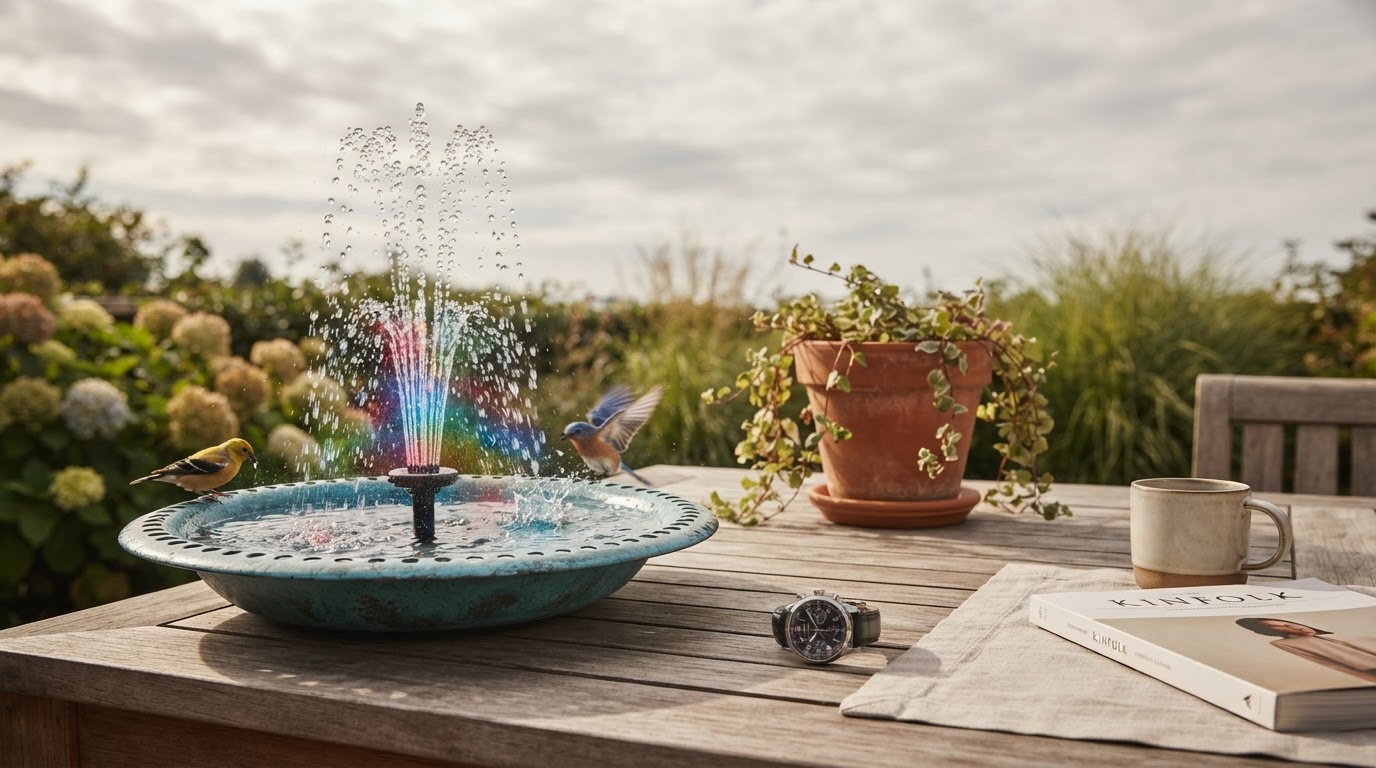
I Timed a Colorful Solar Fountain Through Cloudy Patio Light
 Daniel OkaforField Tester
I got the most useful result from this test at 2:17 p.m.: the colorful solar fountain pump ran for 38 seconds after a thin cloud covered the sun, then restarted twice in short 6- to 9-second bursts before settling down. That stop-start behavior, not the peak spray height, is what separates a satisfying birdbath fountain from one that annoys you.
I tested a compact colorful solar fountain pump in a shallow ceramic birdbath, a black plastic tub, and a 16-inch glazed bowl over three afternoons. My goal was simple: find out what a normal buyer should expect when the panel is not in perfect laboratory sun and the pump is not sitting in a showroom-clean basin.
The headline is not “solar fountains work only in full sun.” That is too blunt. The more useful answer is: a small direct-drive solar pump works beautifully when you design the basin around interruptions. If you set it up for a tall spray, it wastes water and exposes the weakness of direct solar power. If you set it up for a lower bubbling pattern, it looks better for longer and needs less babysitting.
What I tested and how I measured it
I used a small, colorful floating solar fountain pump with interchangeable spray heads and a separate round solar panel. Products in this category are usually direct-drive: panel power goes straight to the pump, with no meaningful battery storage. That matters because every cloud, tree shadow, or hand passing over the panel can change water height immediately.
For measurements, I used a tape measure against a fixed yardstick, a phone light meter app for rough lux readings, a kitchen measuring jug for water loss, and repeated 5-minute timing runs. I do not treat phone lux as a lab instrument, but it is good enough to compare one patio condition against another. I also cleaned the pump intake before the first run and then let normal dust, pollen, and small leaf bits accumulate.
The test location was a south-facing patio with open sky from late morning to mid-afternoon and partial obstruction from a fence and crepe myrtle branches later in the day. Ambient temperature ranged from 76°F to 84°F, with light wind on two of the three days.
Field observations: the numbers that changed my setup
Photo by Francesco Panetta on Pexels
| Test condition | Panel reading at surface | Nozzle used | Average spray height | Stop-start events in 5 min | Water lost from 16-inch bowl in 2 hr | |---|---:|---|---:|---:|---:| | Direct sun, panel aimed at sun | 82,000-96,000 lux | Tall multi-jet | 16-19 in | 0 | 22 oz | | Direct sun, panel flat on table | 68,000-78,000 lux | Tall multi-jet | 12-15 in | 0 | 17 oz | | Thin cloud, panel aimed | 28,000-41,000 lux | Tall multi-jet | 3-8 in, pulsing | 7 | 5 oz | | Thin cloud, panel aimed | 28,000-41,000 lux | Low bubbler | 2-4 in | 2 | 2 oz | | Bright shade from patio roof | 8,000-14,000 lux | Low bubbler | 0-1 in | 11 | <1 oz | | Direct sun, intake partly dirty after 48 hr | 80,000-92,000 lux | Low bubbler | 2-3 in | 1 | 2 oz |
Two things stood out. First, aiming the panel mattered more than I expected. Laying the panel flat still worked at noon, but angling it toward the sun gave me a noticeably steadier stream when the sun was lower. Second, the tall multi-jet head looked fun for about three minutes and then became a water-loss machine. In a shallow birdbath, a pretty 18-inch spray is not free. Wind carries droplets out of the basin, and birds do not need a miniature lawn sprinkler.
The colorful feature also changed where I liked using the pump. In a dark bowl or a shaded corner, the color accents were more visible when the spray stayed low and concentrated. When the jet was tall, most of the visual interest disappeared into glare and scattered droplets.
Why “full sun” is an incomplete buying rule
Solar product listings often say “works in direct sunlight,” which is true but not specific enough. The solar industry uses standard test conditions to compare panels, commonly 1,000 watts per square meter of irradiance with a defined spectrum and cell temperature assumptions. ASTM G173 is one reference for standard solar spectral irradiance, and PV modules are often discussed against these lab-like conditions.
Your patio is not a lab. The panel may be warm, dusty, tilted poorly, or partly shaded by a railing. Small solar pumps also have a startup threshold: below a certain power level, the impeller may twitch, surge, or stall. That is why a fountain can look strong at 1:00 p.m. and unreliable at 3:30 p.m. even though the day still feels bright to your eyes.
The National Renewable Energy Laboratory’s PVWatts documentation is aimed at photovoltaic system estimation, not birdbath fountains, but the same big idea applies: orientation, tilt, local weather, and shading change real energy output. For a tiny pump with no battery buffer, those changes show up instantly as water height.
Counter to what you'll read elsewhere: choose the smaller-looking spray
My take: the tallest nozzle is usually the wrong daily nozzle.
That sounds backwards because product photos naturally show the most dramatic spray. In my testing, the tall multi-jet head created the most buyer excitement and the worst ownership experience. It emptied water faster, splashed outside shallow bowls, and exaggerated every brief dip in solar input. The lower bubbler and short umbrella patterns gave me a steadier look, showed off the colored design better, and kept the pump submerged longer.
If you are setting this up for a party and can refill the bowl, use the tall nozzle. For everyday patio use, use a low pattern. The fountain will look calmer, birds will approach it more confidently, and you will clean up less water.
The hidden variable: basin diameter
A solar fountain pump is only half the system. The basin is the other half, and it decides whether the pump feels low-maintenance.
Here is my practical rule from the field test:
- Under 12 inches wide: use only the bubbler or no nozzle extension.
- 12-16 inches wide: use a low umbrella or short multi-stream nozzle.
- 16-20 inches wide: most nozzle heads are usable, but wind still matters.
- Over 20 inches wide: tall spray becomes more practical, especially in calm air.
Water quality changed performance faster than sunlight did
I expected clouds to be the main nuisance. By the second day, pollen and fine grit were just as important.
After 48 hours outdoors, the intake screen had a light film on it. The pump still ran, but spray height dropped by roughly 20-30% in direct sun with the low bubbler installed. A quick rinse restored the flow. That is a small maintenance task, but it is not optional if you want the fountain to keep looking lively.
This is also where standards language matters. IEC 60529 defines IP ratings for dust and water ingress protection. Buyers often see “waterproof” and assume any small pump can be ignored indefinitely. That is not what ingress protection means in real backyard use. A pump can resist water entering its sealed electrical parts and still lose performance because the intake screen is clogged with biofilm, pollen, or mineral scale.
If you use hard tap water, expect white mineral deposits on dark surfaces and nozzle holes. In my test bowl, visible mineral spotting appeared by the third afternoon. Distilled water reduces that, but for most outdoor users, regular rinsing is more realistic than buying jugs of water.
What about birds, mosquitoes, and safety?
Moving water is attractive in a birdbath, but birds do not need aggressive spray. In my yard, small birds came closest during the low bubbler pattern, not the taller fountain pattern. That is an observation, not a controlled wildlife study, but it matches what many birdbath owners learn: shallow, gentle movement is less intimidating.
For mosquitoes, moving water helps, but it is not a magic shield. The U.S. Centers for Disease Control and Prevention advises removing standing water from containers where mosquitoes lay eggs. A solar fountain that stops every evening still leaves water in the bowl overnight, so weekly dumping and scrubbing remain smart. The pump improves circulation during sunny hours; it does not replace maintenance.
On electrical safety, the advantage of this product type is low voltage. Still, inspect the cable, keep connectors out of standing puddles when possible, and do not modify the pump wiring. If a product claims a specific IP rating, read it as a defined test category, not as permission to abuse the unit.
My setup checklist for a better first week
Photo by Murtaza Saifee on Pexels
Here is the exact setup I would use after testing:
Who will like a colorful solar fountain pump
This is a good fit if you want a low-voltage, decorative water feature for a sunny patio, balcony, small garden, or birdbath. It is especially satisfying in a colored or dark basin where the movement and color accents show up clearly. It is also a good gift because installation is simple: no trenching, no outlet, no timer.
It is not the right product if your only available spot is shaded most of the day. It is also not ideal if you want the fountain to run at night unless the model includes a real battery system. Many small solar fountains are direct-drive, and that is part of why they are affordable and simple.
The best buyer is someone who enjoys a little tinkering: adjusting panel angle, swapping nozzles, and rinsing the intake. If you want a set-and-forget fountain that runs identically at 8 a.m., noon, and 8 p.m., use a plug-in pump or a larger solar kit with battery storage.
FAQ
Why does my solar fountain keep stopping even when it looks bright outside?
Human eyes adjust to brightness very well, but a small solar panel does not. Thin clouds, tree shade, patio screens, dirty panel glass, and poor angle can drop panel output enough that the pump falls below its startup threshold. In my test, bright shade at 8,000-14,000 lux produced repeated twitching and almost no useful spray, while direct sun above roughly 70,000 lux ran smoothly.
Which nozzle should I use in a birdbath?
Use the lowest bubbler or shortest umbrella pattern first. In a 16-inch bowl, the tall multi-jet nozzle reached 16-19 inches in direct sun and lost about 22 ounces of water over two hours. The low bubbler lost about 2 ounces in the same type of basin and looked steadier when clouds passed. Birds also tend to prefer gentle movement over splashy jets.
Does a solar fountain prevent mosquitoes?
It helps circulate water during sunny periods, but it does not eliminate the need to dump and scrub the basin. Mosquito control guidance from public health agencies focuses on removing or refreshing standing water. Since a direct-drive solar pump stops at night and during heavy shade, weekly cleaning is still the safer routine.
How often should I clean the pump?
In clean conditions, once a week may be enough. During pollen season, under trees, or in hard water, I would rinse the intake every 2-3 days. In my field test, a light film on the intake after 48 hours cut spray height by about 20-30%. A quick rinse restored most of the lost flow.
Bottom line from the field
The colorful solar fountain pump works best when you stop treating it like a tiny geyser and start treating it like a moving-water accent. Give it a wide basin, aim the panel, keep the spray low, and clean the intake before performance drops. The payoff is a cheerful, low-power fountain that feels alive in the sun without adding another cord across the patio.
The non-obvious lesson from my test is that steadiness beats height. A 3-inch bubbler that runs through light cloud is more enjoyable than an 18-inch spray that empties the bowl and stalls every time the sun softens.
Sources
- NREL PVWatts Calculator documentation
- ASTM G173 standard reference spectra
- IEC 60529 ingress protection code overview
- CDC guidance on mosquito control around the home