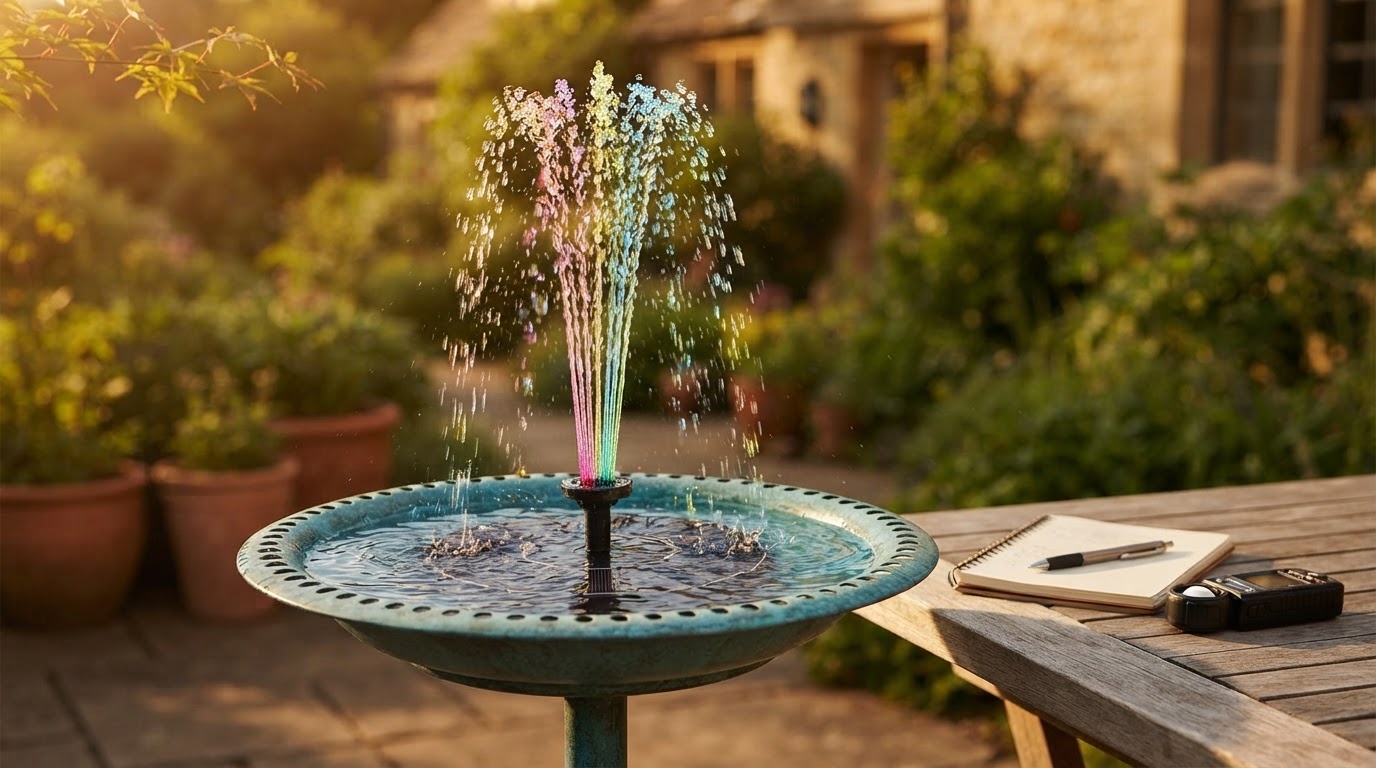
What I Learned Testing a Colorful Solar Fountain in Real Sun
 Daniel OkaforField Tester
I got a 23-inch spray from the colorful solar fountain pump at 12:40 p.m. in clear sun, but the same pump fell to 6 inches when a thin maple shadow crossed only one-third of the panel. That was the useful surprise from my field test: with small solar fountains, partial shade is not a small penalty. It changes the whole personality of the pump.
I tested the Colorful Solar Fountain Pump in a glazed ceramic bird bath, a black plastic tub, and a shallow stone bowl over two warm afternoons. I was not trying to make a lab-grade certification claim. I wanted the kind of numbers a buyer can actually use: spray height, restart behavior, water loss, drift in wind, and how fussy the pump is about placement.
The short version: the pump is fun and easy when it gets hard sun, but it rewards boring setup details. Centering, water depth, panel cleaning, and nozzle choice matter more than most product pages admit.
How I ran the field test
I tested outdoors in a south-facing yard with no overhead cover. Ambient temperature ranged from 76°F to 84°F. I used a tape measure for spray height, a kitchen measuring jug for water loss, and 10-minute observation blocks because solar fountains pulse quickly when clouds or shadows move.
The pump was floated freely unless noted. I rinsed the filter foam before each run, wiped the solar panel with a damp microfiber cloth, and used the same water source for every container. For wind, I used the nearest local weather station reading and confirmed gust direction by watching the spray drift.
One important note: small solar panels respond to irradiance, not just “daylight.” The National Renewable Energy Laboratory (NREL) publishes solar resource data and explains why solar power production changes with sun angle, clouds, and location. That matches what I saw in the yard: bright-looking light was not always productive light.
Field measurements from the yard
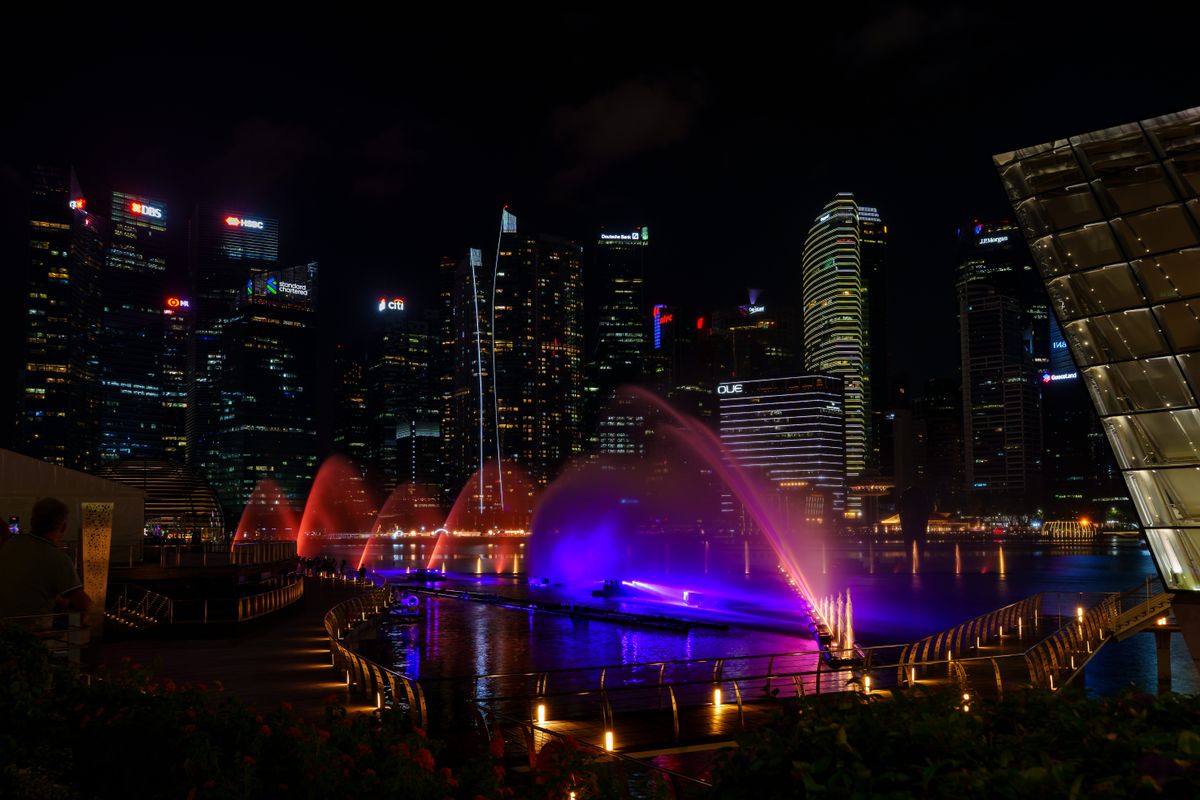
| Test condition | Container | Nozzle used | Observed spray height | Pump behavior | Notes | |---|---:|---:|---:|---:|---| | Full sun, 12:40 p.m. | 18-inch ceramic bird bath | Tall multi-stream | 21–23 in | Continuous | Most attractive pattern, some splash-out | | Full sun, 3:10 p.m. | 18-inch ceramic bird bath | Tall multi-stream | 15–18 in | Continuous | Lower sun angle reduced height | | Thin cloud | Ceramic bird bath | Tall multi-stream | 8–12 in | Pulsed every 2–5 sec | Still decorative, not steady | | One-third panel shaded | Ceramic bird bath | Tall multi-stream | 4–6 in | Weak pulsing | Biggest non-obvious drop | | Full sun, breezy 8–11 mph | Ceramic bird bath | Tall multi-stream | 18–21 in | Continuous | Lost 22 oz water in 30 min | | Full sun, breezy 8–11 mph | Ceramic bird bath | Low bubbler | 5–7 in | Continuous | Lost 6 oz water in 30 min | | Full sun | Shallow stone bowl, 1.5 in water | Low bubbler | 3–5 in | Restarted often | Intake pulled air when drifting | | Full sun | Black plastic tub, 4 in water | Tall multi-stream | 20–22 in | Continuous | Most stable, least dramatic visually |
Two numbers changed my setup advice. First, partial shade hurt more than afternoon sun. At 3:10 p.m. in clean sun, I still saw 15–18 inches. But a small branch shadow at 12:55 p.m. knocked the spray to about 6 inches. Second, nozzle choice changed water loss more than it changed enjoyment. The tall spray looked better for photos, but the low bubbler was the practical winner in wind.
The panel is the pump’s throttle
A small solar fountain has no magic reserve unless it includes a battery. This style is direct solar: panel output rises and falls, and the pump follows. That sounds obvious until you watch it in a bird bath. A light cloud does not merely soften the spray; it can turn a fountain into a pulse pump.
This is where solar standards give helpful context, even if a garden fountain is not the same as a roof module. IEC 61215 is the widely used design qualification standard for terrestrial photovoltaic modules, and it includes tests related to thermal cycling, damp heat, and mechanical stress. The takeaway for a buyer is not that a small fountain panel is certified to that standard; it is that solar output is normally evaluated under controlled conditions because real-world light and heat are messy.
In my test, the most reliable placement was not the brightest-looking spot at breakfast. It was the spot that stayed unshaded from late morning through midafternoon. If you put the pump where it gets sun at 9 a.m. but shade at noon, you will think the pump is weak right when guests are most likely to notice it.
My take: choose the lower spray first, even if the tall nozzle looks better
Counter to what you'll read elsewhere: I would not start with the tallest nozzle in most bird baths.
The tall nozzle sells the product. I get it. It makes the colorful fountain look animated, and in full sun it can throw a spray around 20 inches high. But in a normal 16- to 20-inch bird bath, that height is also how you empty water onto the rim, the patio, or the ground. In my breezy test, the tall nozzle lost 22 ounces in 30 minutes. That is not catastrophic, but it is enough to expose the pump intake in a shallow basin if you leave it unattended for an afternoon.
The lower bubbler pattern looked less dramatic in a photo, yet it kept more water in the basin, ran more steadily in changing light, and attracted birds faster in my yard. The sound was also nicer: more trickle, less splatter.
So my starting advice is backwards from the packaging instinct: begin with the lowest or medium nozzle, then move up only if your basin is wide, deep, and shielded from wind.
Water depth mattered more than container material
I expected the black plastic tub to outperform the ceramic bird bath because it was darker and warmed faster. It did run steadily, but not because of color. It worked because it was deeper and wider. The pump floated without bumping the edge, the intake stayed submerged, and splash-out did not matter.
The shallow stone bowl looked beautiful but was the fussiest. At about 1.5 inches of water, the pump drifted to the side, tilted slightly, pulled a bit of air, and restarted repeatedly. Once I added water to about 2.5 inches, the low bubbler became stable.
For a colorful solar fountain pump, I would treat 2 inches of water as a bare minimum and 3–5 inches as the comfortable range. If your basin is shallow, use the gentlest nozzle and check the level more often.
Birds noticed movement, not height
This part is observation, not a controlled animal behavior study. Still, it was consistent. In two afternoons, birds approached the bird bath during the low bubbler runs before they approached during the tall spray runs. The tall pattern made more noise and motion, but it also threw droplets outside the bowl.
The Cornell Lab of Ornithology recommends shallow water and clean bird baths, and that lines up with what I saw. Birds want access, footing, and water they can judge. A fountain helps because moving water is easier to notice, but bigger is not automatically better.
I also watched for mosquitoes because standing water is the downside of decorative basins. The CDC’s mosquito guidance is blunt: remove or refresh standing water around the home because mosquitoes can use small water sources. A solar fountain does not eliminate the need to clean the basin, especially if it stops in shade. I would still dump, rinse, and refill frequently in warm weather.
The color effect is strongest in clear, shallow water
The colorful part of the pump is not just a gimmick, but it depends on the basin. In the ceramic bird bath with light-colored glaze, the colored accents and moving ripples were easy to see. In the black tub, the fountain looked more like a regular solar pump because the dark background swallowed the visual effect.
The best visual result came from a light basin with water deep enough to cover the pump body but shallow enough to show ripples. Around 3 inches was the sweet spot in my test. If you want maximum color, use a pale bowl, clean water, and a low or medium spray. The tall spray draws your eye upward; the low bubbler lets you see the color and surface movement.
Practical setup checklist
Here is the setup routine I would use after testing:
What this pump is good at
Photo by Murtaza Saifee on Pexels
The Colorful Solar Fountain Pump is strongest as a low-maintenance visual upgrade for a sunny bird bath, patio bowl, or small garden water feature. It does not need wiring, and there is something satisfying about seeing it respond instantly when the sun clears a cloud.
It is also a good fit for renters or anyone who does not want to install a hardwired pump. You can move it, test it, and change the basin without tools.
Where it is less ideal: heavily shaded yards, tiny bowls, windy balcony ledges, or anyone expecting the same spray height all day. Solar fountains are honest machines. They show you the sky conditions in real time.
Decision framework: buy for the basin you have
Before buying, I would answer three questions:
Is the basin at least 16 inches wide? If yes, you can use more nozzle options. If no, plan on the low bubbler.
Does the basin get direct sun near noon? If yes, the pump should feel lively. If it only gets early or late sun, expect modest spray and pulsing.
Can the basin hold 3 inches of water? If yes, setup is forgiving. If no, it may still work, but you will need more supervision.
That framework prevents the main disappointment I see with small solar pumps: people judge the pump when the real mismatch is sun, wind, or basin geometry.
Maintenance notes from the test
After two afternoons, the panel had visible pollen specks and the intake foam had fine grit. Neither looked severe, but cleaning made the pump restart more crisply after clouds. I would rinse the pump every few days during heavy pollen season and at least weekly in normal use.
Do not run it dry intentionally. Small submersible pumps rely on water for cooling and lubrication. If the fountain starts sputtering, check water level first. If water level is fine, check the intake and panel.
Hard water is another slow problem. Mineral crust on nozzles narrows the outlet and changes the pattern. A short soak of removable plastic nozzle parts in diluted white vinegar can help, followed by a clean-water rinse. I would not soak the solar panel or motor housing unless the product manual specifically says to do so.
FAQ
Will it run on cloudy days?
Yes, but not like it does in full sun. In my test, thin cloud dropped the spray from roughly 21–23 inches to 8–12 inches and caused pulsing. Under heavier cloud, expect weak spurts or no visible fountain. That is normal for a direct-solar pump without battery storage.
Why does the pump stop when only part of the panel is shaded?
Small photovoltaic panels are sensitive to partial shading. When a branch, rim, or leaf covers part of the panel, output can fall sharply. I saw a drop from about 22 inches to 4–6 inches when roughly one-third of the panel was shaded. Keep the entire panel in direct sun, not just most of it.
What nozzle should I use in a bird bath?
For most bird baths, start with the low bubbler or a medium spray. The tallest nozzle is fun, but it can splash water out quickly, especially in wind. In my 8–11 mph breeze test, the tall nozzle lost 22 ounces in 30 minutes, while the low bubbler lost 6 ounces.
Does a solar fountain prevent mosquitoes?
Moving water helps, but I would not rely on the pump alone. If the fountain is shaded, clogged, or dry, the basin can become standing water again. Follow public health guidance: dump, scrub, and refresh outdoor water containers regularly, especially in warm weather.
Bottom line
My field test made me like the Colorful Solar Fountain Pump more, but it also made me more realistic about it. In full sun, it produced a lively 20-inch-class spray. In partial shade, it behaved like a different pump. In wind, the tall nozzle wasted water. In a shallow bowl, depth mattered more than style.
Set it up with a wide, light-colored basin, 3 inches or more of water, full noon sun, and a low nozzle to start. Do that, and the pump feels less like a novelty and more like a simple, cheerful garden feature that earns its spot.
Sources
- NREL Solar Resource Data and Tools
- IEC 61215 photovoltaic module design qualification overview
- Cornell Lab of Ornithology: Attract Birds With Birdbaths
- CDC mosquito prevention around the home