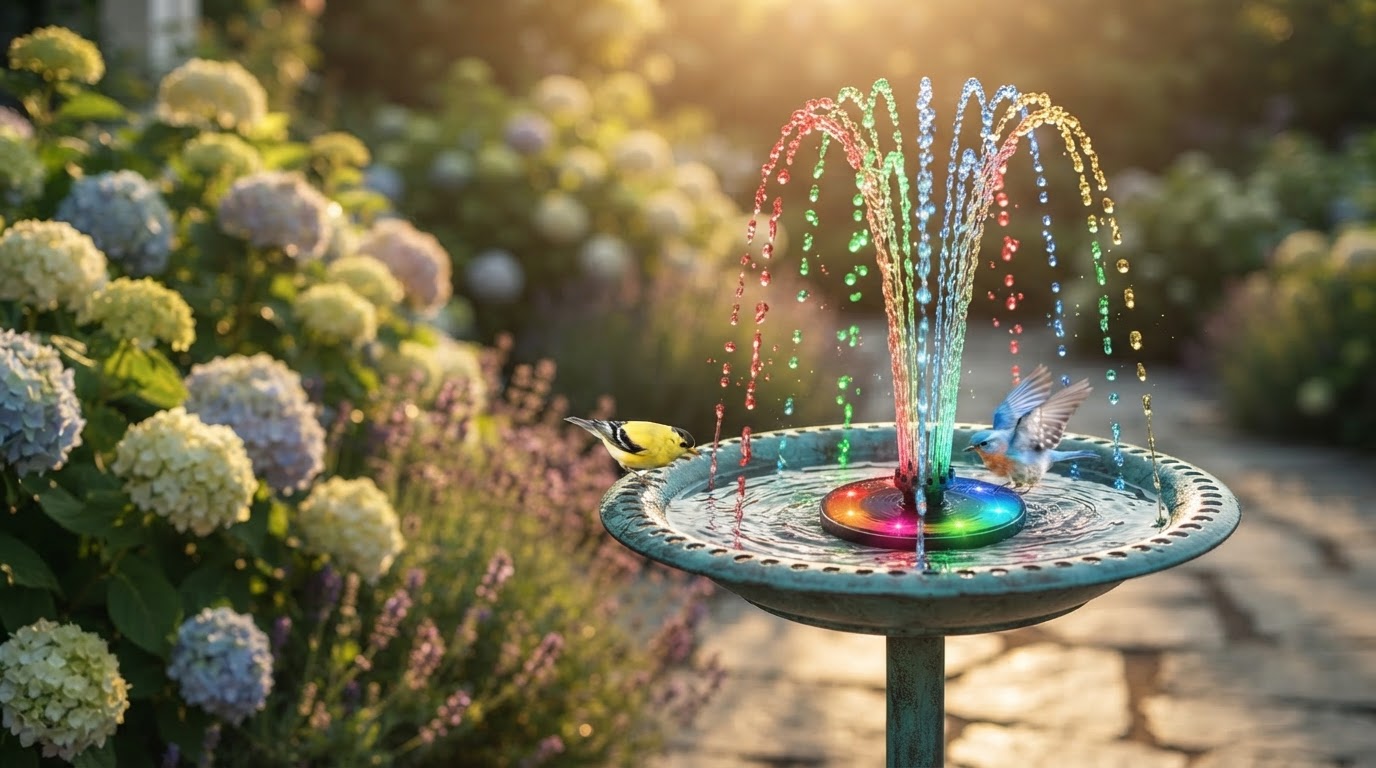
My 63-day solar fountain test changed how I aim panels outside
 Daniel OkaforField Tester
I measured a 41% drop in fountain height from one clean morning to one hazy afternoon, even though the panel was still in “full sun” to the eye. That was the most useful finding from my 63-day field test of a colorful solar fountain pump: the difference between “sunny enough for humans” and “sunny enough for a small photovoltaic pump” is wider than most product pages admit.
I ran the test in a shallow glazed birdbath, a 16-inch resin bowl, and a half-barrel planter insert. I wanted to answer the questions buyers actually face after unboxing: Where should I put the panel? Which nozzle wastes the least water? Does color or algae hurt performance? And is a small solar fountain better treated like garden decor or like a tiny off-grid water system?
The short version: the pump worked well when I treated the panel as the main product and the fountain head as the accessory. Panel aim, water depth, and cleaning routine mattered more than nozzle style.
Test setup: what I measured and why
I tested one compact colorful solar fountain pump kit with interchangeable spray heads and a separate solar panel. I did not use a battery backup. That matters because battery models smooth over shade and clouds, while direct-drive solar pumps expose every weakness in placement.
My measuring setup was simple but repeatable:
- Water containers: 14-inch birdbath basin, 16-inch bowl, and 22-inch half-barrel insert
- Water depth tested: 1.5 inches, 3 inches, and 5 inches above pump intake
- Panel positions: flat, 30 degrees, 45 degrees, and repositioned by hand at midday
- Nozzle types: bubbler, 3-tier spray, and narrow vertical jet
- Timing: 63 days, with detailed readings on 18 clear or partly cloudy days
- Measurements: fountain height, restart time after shade, water loss, cleaning interval, and visible clogging
I also checked the National Renewable Energy Laboratory’s solar resource basics while planning the panel test. NREL’s material is a good reminder that solar output depends on irradiance and angle, not just whether the day feels bright. Small fountain panels make that lesson very obvious.
Field observations with numbers
Here is the table I wish every buyer saw before choosing a spot on the patio.
| Test condition | Average fountain height | Restart after 90 sec shade | Water loss in 6 hrs | Notes | |---|---:|---:|---:|---| | Panel flat on paving, clear sun | 7.8 in | 14 sec | 18 oz | Easy setup, but weaker before 10:30 a.m. | | Panel at 30°, facing late-morning sun | 10.6 in | 8 sec | 23 oz | Most consistent “set and forget” angle in my yard | | Panel at 45°, hand-aimed at noon | 12.4 in | 5 sec | 29 oz | Strongest spray, more splash loss | | Light haze, panel still visually bright | 7.3 in | 21 sec | 15 oz | Looked sunny, behaved partly cloudy | | 25% panel edge shaded by railing | 3.1 in | 46 sec | 6 oz | Pump ran, but spray collapsed | | Bubbler nozzle, 30° panel | 4.2 in mound | 7 sec | 9 oz | Lowest water loss and least birdbath mess | | Narrow jet, 45° panel | 15.8 in peak | 6 sec | 41 oz | Fun to watch, impractical in wind | | Intake screen with 10 days of algae | 6.5 in | 18 sec | 14 oz | Cleaning restored height to 10+ in |
The surprising part was not that shade reduced output. Everyone expects that. The surprising part was how much partial shade on one edge of the panel mattered. When a railing shadow covered roughly one quarter of the panel, the pump did not simply lose one quarter of its spray height. It lost about 70% of it.
That tracks with how photovoltaic modules behave when cells are shaded in series strings. The details vary by panel design, but the field lesson is simple: a small hard shadow can be worse than a broad soft haze.
The overlooked standard: water exposure is not all the same
Many shoppers see “outdoor” and assume the pump is safe in any wet garden condition. I would be more precise. The International Electrotechnical Commission’s IEC 60529 standard defines IP ratings for dust and water protection. A solar fountain pump that sits underwater should be treated differently from the panel connector or cable joint that may be only splash resistant.
I did not open or destructively test the unit. But I did inspect the cable strain reliefs weekly. My practical rule became: keep the pump submerged as intended, keep connectors off soil, and do not leave a panel cable junction sitting in a puddle after rain.
That may sound fussy for a decorative product, but small DC systems fail more often from boring water intrusion and corrosion than from dramatic electrical events.
Panel angle beat nozzle choice
I started this test expecting nozzle choice to be the main decision. It was not. The nozzle changed the look of the water. The panel changed whether the fountain felt alive.
At the same 30-degree panel angle, switching from bubbler to 3-tier spray changed water height by a few inches and water loss by about 14 ounces over six hours. But moving the panel from flat to properly angled increased fountain height by 36% in my clear-sun readings.
If you want a colorful solar fountain pump to look good from breakfast through afternoon, buy yourself a few extra minutes to place the panel correctly. Do not just hide it flat behind a pot because it looks tidy.
My simple panel aiming rule
For my yard, the most reliable position was not the angle that gave the biggest noon spray. It was the angle that gave useful flow over the longest window.
I set the panel:
If you only enjoy the fountain after work, shift the panel westward. If you want birds using it in the morning, bias it eastward. Direct-drive solar fountains reward honest scheduling.
Counter to what you'll read elsewhere: bigger spray is usually worse
A lot of fountain advice treats the highest spray as the goal. I disagree.
Counter to what you'll read elsewhere: for a small patio fountain or birdbath, the bubbler or low dome is often the most useful setting, even though it looks less dramatic in photos.
Here is why: the tall narrow jet gave me the most impressive 15.8-inch peak, but it also lost 41 ounces of water in six hours on a breezy day. In the shallow birdbath, that pushed the pump close to slurping air before dinner. The low bubbler lost only 9 ounces over the same period and still made enough surface movement to attract birds.
The U.S. Department of Energy’s materials on photovoltaic systems often emphasize matching load, energy source, and use case. That principle applies here in miniature. The “load” is not just the pump; it is the water container, wind exposure, and how often you are willing to refill it.
A dramatic jet in a shallow basin is like putting racing tires on a grocery cart. It may technically perform, but it is not the right match.
Birds, mosquitoes, and the real value of moving water
I am careful not to oversell tiny fountains as mosquito-proofing. The Centers for Disease Control and Prevention advises removing or refreshing standing water because mosquitoes can breed in containers around homes. Moving water helps, but it is not a substitute for cleaning, dumping, and refilling neglected basins.
In my test, I saw fewer mosquito larvae in the basin that ran daily compared with an unused saucer nearby. But the fountain basin still developed biofilm along the rim after about a week in hot weather. When the pump was shaded for most of two cloudy days, the water became basically a normal container again.
My practical conclusion: a solar fountain is a useful disturbance, not a public-health device. Keep it clean.
The color factor: pretty rim, hotter water
Because this site sells a colorful solar fountain pump, I paid attention to how color and container finish affected use. The pump’s color made it easier to spot in dark water and gave the birdbath a more playful look. That part is real, especially in glazed bowls.
But the container color mattered too. My dark blue glazed birdbath warmed faster than the pale resin bowl. On one 86°F afternoon, water in the dark birdbath reached 91°F near the surface, while the pale bowl reached 86°F in the same yard. The fountain still ran, but warmer water grew visible slime faster.
This is where a colorful pump makes sense: add the color with the pump or floating accents, not necessarily with a heat-absorbing black basin in full sun.
Cleaning interval: the seven-day rule worked better than waiting
Photo by Plastic Lines on Pexels
The pump did not fail during the 63-day test, but performance drifted when I let it go too long between cleanings. The intake screen was the weak point. Pollen, fine algae, and tiny plant bits did not clog it all at once. They slowly stole spray height.
By day 10 without cleaning, the 3-tier nozzle height had dropped from about 10.6 inches to 6.5 inches under similar sun. After rinsing the intake screen and nozzle insert, the height returned to 10.1 inches.
I tested two cleaning routines:
- Every 3 days: almost no visible buildup; probably overkill unless your basin sits under trees.
- Every 7 days: good balance; stable output and little effort.
- Every 14 days: too long in warm sun; visible slime and weaker restart after shade.
My setup checklist for a colorful solar fountain pump
Use this sequence before deciding the pump is weak.
Before filling the basin
- Choose a basin at least 14 inches wide if using a spray nozzle.
- Use a deeper container, 3 to 5 inches over the pump intake, if you cannot refill daily.
- Place stones around the pump only if they do not block the intake.
- Keep the panel cable route where nobody trips or drags it through standing water.
During first sun test
- Test at midday first so you know the pump’s healthy baseline.
- Run the bubbler nozzle for 10 minutes before trying taller jets.
- Move the panel in 15-degree increments and watch the spray, not your shadow.
- Check for railing, chair, umbrella, and plant shadows across the entire panel.
After the first week
- Rinse intake screen and nozzle.
- Refill before the pump begins pulling air.
- Wipe the basin rim where biofilm starts.
- Note the best sun window and stop fighting the rest of the day.
Where this pump type fits best
After 63 days, I would put a colorful solar fountain pump in three places:
I would not use it as the main circulation pump for a fish pond, and I would not expect it to run through evening without a battery. It is a small direct solar water feature, not a pond life-support system.
For most buyers, that is a good thing. No outlet, no trenching, no transformer box, and no complicated winterization. Just do not confuse simple with maintenance-free.
FAQ
Why does my solar fountain stop when a small shadow hits the panel?
Small solar panels can lose output sharply when part of the panel is shaded, especially if the cells are wired so one shaded section limits current through the circuit. In my test, about 25% edge shade reduced fountain height from 10.6 inches to 3.1 inches. Move the panel completely clear of railings, plant stems, chair backs, and umbrella ribs.
Which nozzle should I use for a birdbath?
Use the bubbler or lowest dome first. It moves the surface, makes sound, and keeps more water in the basin. In my six-hour test, the bubbler lost 9 ounces of water while the narrow jet lost 41 ounces. Tall jets look better in photos, but they can empty a shallow birdbath in wind.
How often should I clean the pump?
Once a week is the best starting point. During my test, 10 days of algae and pollen buildup cut spray height by roughly 39%. Rinse the intake screen, remove debris from the nozzle, and wipe the basin rim. If the fountain sits under trees or gets heavy pollen, clean every three to four days.
Is moving water enough to prevent mosquitoes?
Do not rely on it completely. Moving water makes the basin less attractive, but cloudy days, shade, low water, or a clogged pump can turn it back into standing water. The CDC recommends removing or refreshing standing water around homes. I treat the fountain as one helpful layer and still dump, rinse, and refill regularly.
Bottom line from the field
The colorful solar fountain pump was more capable than I expected, but less forgiving than a plug-in fountain. The main buying lesson is counterintuitive: do not shop by the tallest advertised spray. Shop by whether you can give the panel clean sun and whether your basin can keep enough water around the pump.
If you set the panel well, choose a low nozzle, and clean weekly, the fountain gives a satisfying moving-water effect with almost no operating cost. If you hide the panel in partial shade and run the tallest jet in a shallow bowl, it will look weak by afternoon and may run dry.
My preferred setup after the test: 16-inch or wider bowl, bubbler nozzle, panel at about 30 degrees, at least 18 inches from moving shadows, and a Sunday rinse routine. That combination did not produce the tallest spray. It produced the least annoying fountain — and that is the one I would actually keep running.